
Downtown Reno
National Automobile Museum
Over two hundred cars from the Harrah collection, staged in period street scenes. The best indoor thing in Reno, and it is not close.
Reno has fewer attractions than a city of its size usually does, and one that is better than a city of its size has any right to. That is the honest shape of it: a short list, worth doing, rather than a long one padded out.
Almost everything below is downtown and walkable from the casino core. The exceptions are the ones that need a car, and they are marked.
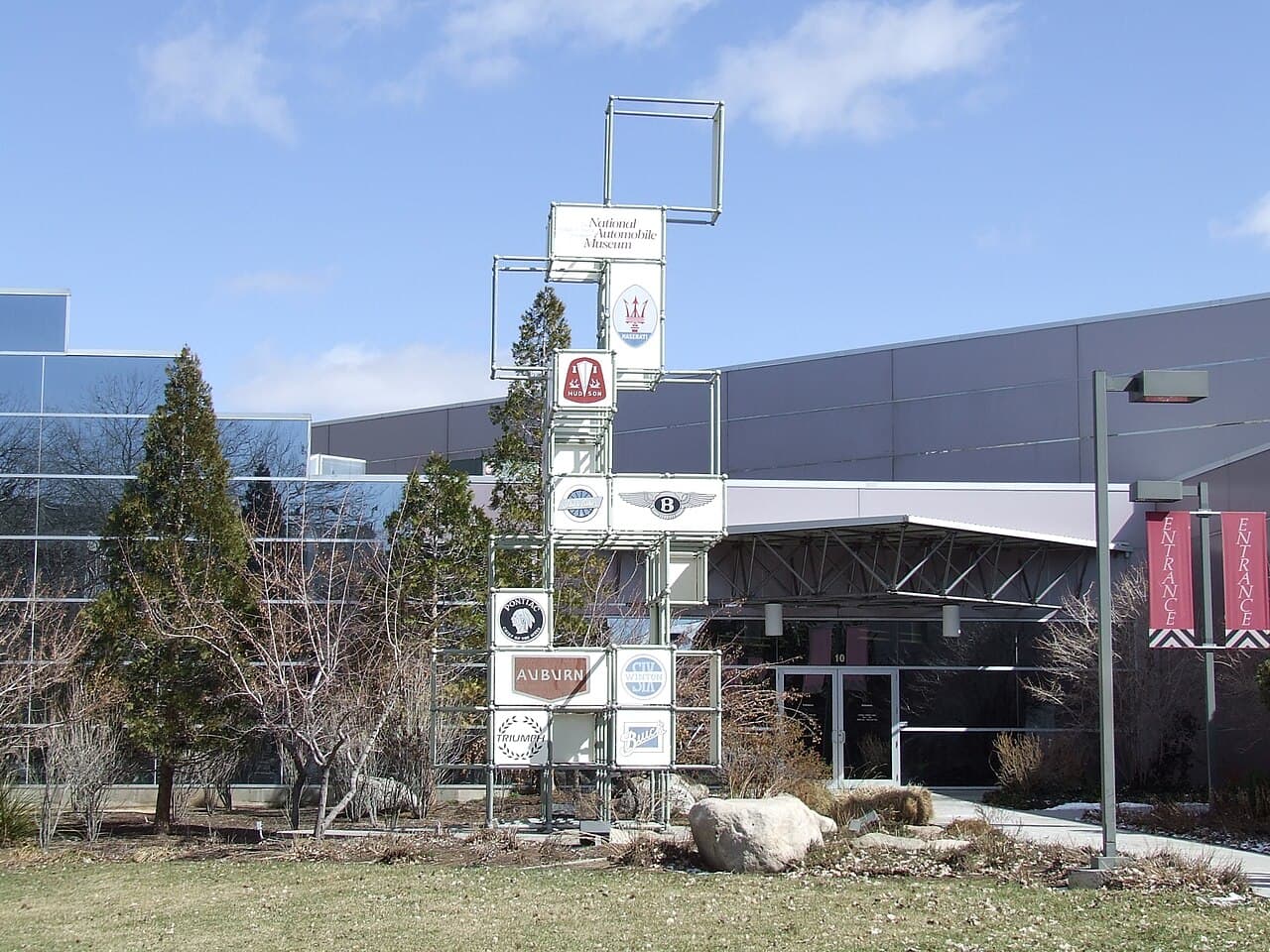
Bill Harrah, who built the casino company, assembled one of the largest private car collections in the world. It was broken up after his death and a few hundred of the best cars stayed in Reno as a museum. That is the reason a city this size has a collection this good, and it is the single strongest argument for spending an afternoon indoors here.
The cars are staged in period street scenes rather than lined up, which is what makes it work for people who do not care about cars. Allow an hour and a half.
All three are within about a mile of the Arch, and between them they cover a hot afternoon, a cold one and a wet one — Reno supplies all three.
Over two hundred cars from the Harrah collection, staged in period street scenes. The best indoor thing in Reno, and it is not close.
Nevada's only accredited art museum, in a black cliff-like building two blocks off Virginia Street. Strong on art about landscape and environment.
Reno's hands-on science museum — 67,000 square feet of things children are allowed to touch, at the south end of downtown.
Both of these appear as open attractions on general travel sites. One is closed for a long renovation and the other runs a season, and one of them is a forty-minute drive into the foothills.
A 38-acre wildlife sanctuary in the foothills north of Reno, giving permanent homes to animals that cannot be returned to the wild. Open March to November only.
The university's full-dome planetarium on North Virginia Street — closed to drop-in visitors for renovation until early 2027.
The best-known thing in Reno is a sign, and it costs nothing. The Reno Arch over Virginia Street is the photograph everyone takes, and it is at its best at dusk when the neon reads against a lit sky rather than a black one.
Two blocks south the Truckee runs straight through the middle of downtown, and Wingfield Park carries a free engineered whitewater course through it. It reopened in June 2026 after more than a year behind construction fence for the Arlington bridge replacement, so older guides describe it wrongly in one direction or the other.
Beyond that the parks are the attraction — a rose garden, a paved mile round a lake, and 580 acres with an arboretum and a museum in it at Rancho San Rafael.
You do not have to gamble to find the casino floors worth walking through, and most first-time visitors should. They are free, they are open at every hour, and three of the downtown properties are joined by enclosed skywalks so the whole block can be crossed without going outside.
Which ones are worth the walk, which are dated and which one closed in 2020 and is still listed everywhere are covered properly in the casino guide. Their showrooms are also where most of the touring acts play, which is the nightlife side of the same buildings.
Reno’s best asset is what surrounds it. Virginia City is a Comstock silver town forty minutes up Geiger Grade, largely intact and genuinely strange. Lake Tahoe is under an hour to the nearest shore.
Both are drives, and the honest position on Tahoe is that almost nothing sold as a Tahoe tour actually collects you in Reno — which is covered, with the exceptions, on the Tahoe from Reno page.
This page is about what each thing is. Putting them in an order — with times, walking distances and where to eat in between — is a different job, and it is already done.